What size rebar for the job.
The short version: 10mm for ties, CHB and slab-on-grade, 12mm for slabs and light footings, 16mm for columns and beams on typical low-rise work. The table below is the common Philippine practice — where a structural design exists, the design governs. Full sizes and weights are on the deformed bar page.
Common sizes by member
Commonly seen on low-rise homes — for reference only, not a design recommendation. The signed structural plan governs.
| Member | Typical bar | Notes |
|---|---|---|
| Slab on grade | 10mm | 200–300mm both ways |
| Suspended slab | 12mm main · 10mm distribution | Spacing per design |
| Footings, 1–2 storey | 12–16mm | Both ways, mat per design |
| Columns, 1–2 storey | 16mm verticals | 4–6 pieces typical, 10mm ties |
| Beams, 1–2 storey | 16mm top and bottom | 10mm stirrups |
| Stirrups and ties | 10mm | 8mm only on light, non-critical work |
| CHB walls | 10mm | Vertical at 400–600mm, horizontal every 3rd course |
These are rule-of-thumb figures for typical low-rise work. Seismic detailing, storey count, soil and spans all move the numbers — where there is a structural plan, follow the plan, not this table.
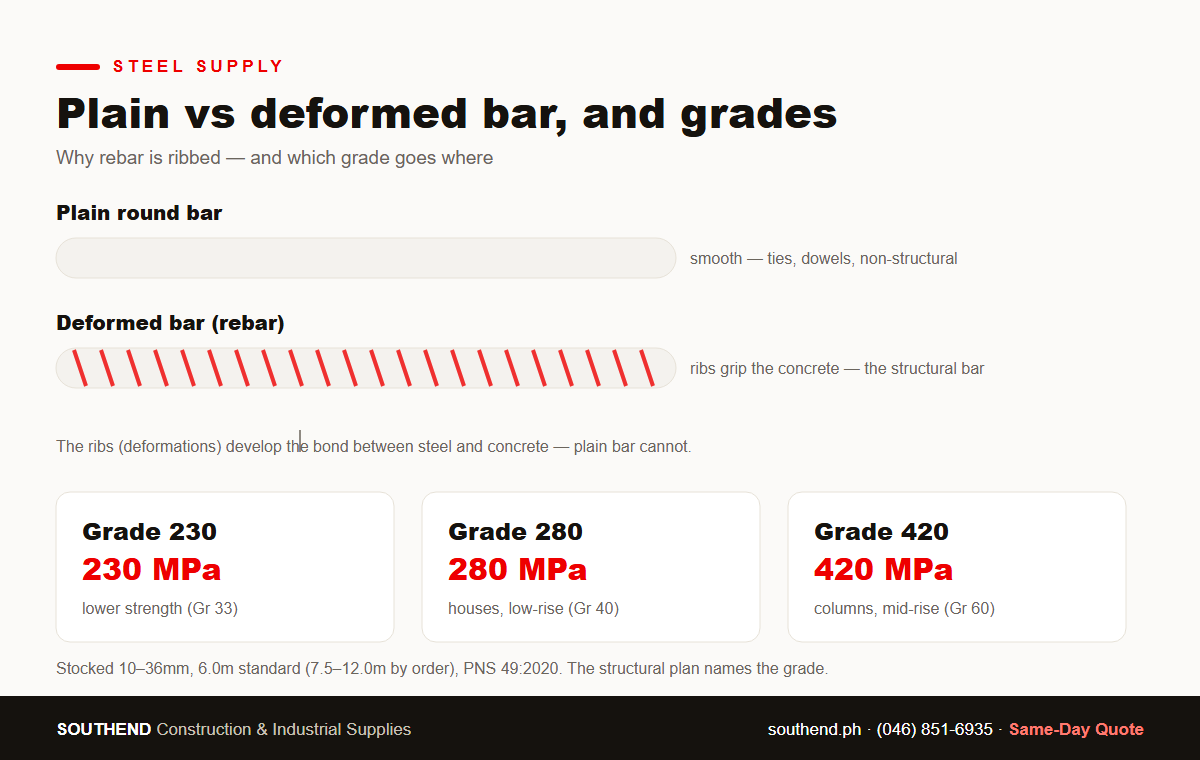
Grade 33, 40 or 60
- Grade 280 (Grade 40) — 280 MPa — the common supply for houses and low-rise. Bends cleanly on site.
- Grade 420 (Grade 60) — 420 MPa — where the design calls for it: columns, critical members, mid-rise and up. Stronger per bar, stiffer to bend and cut.
- Grade 230 (Grade 33) — 230 MPa — lower strength; used where the design permits.
Estimating: pieces per ton
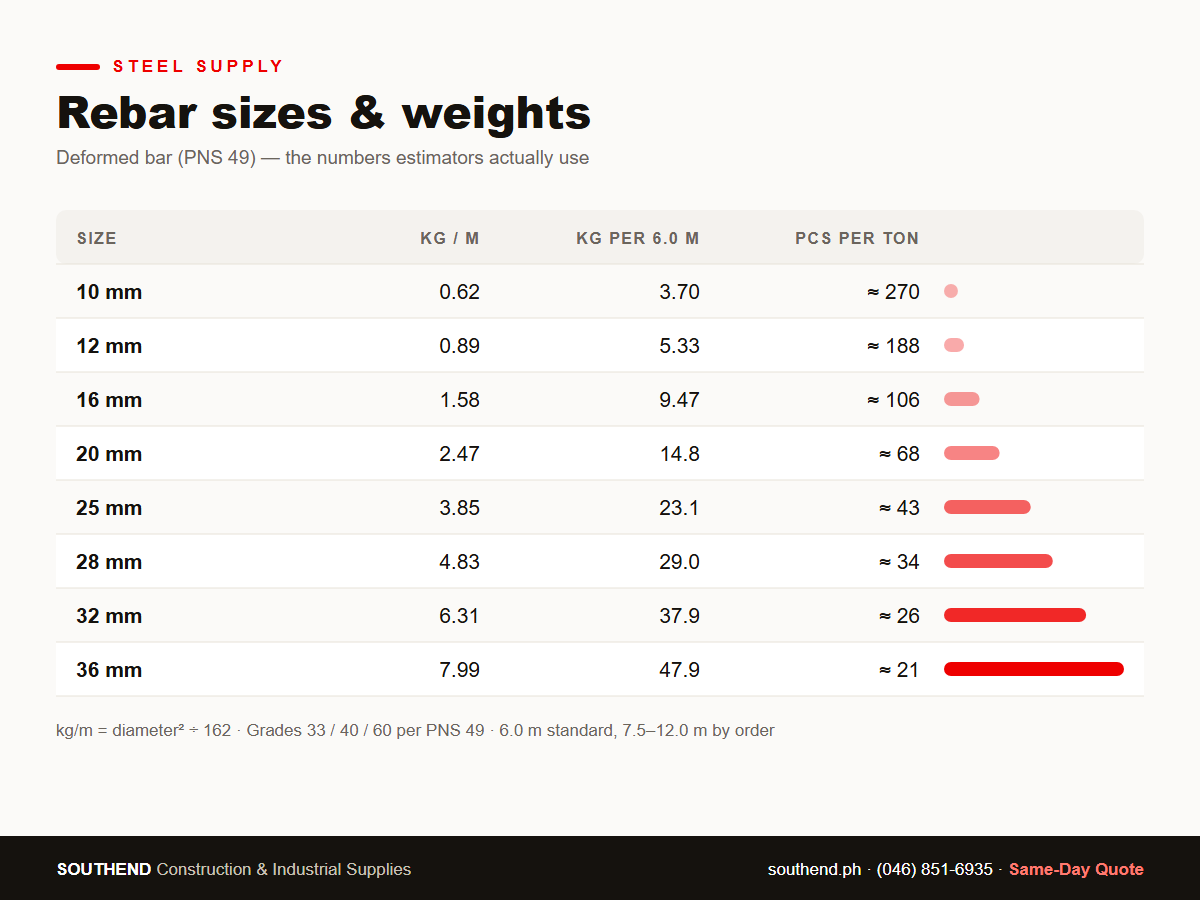
6.0m standard length · kg/m = diameter² ÷ 162
| Size | kg/m | kg per 6 m | Pieces per metric ton |
|---|---|---|---|
| 10mm | 0.62 | 3.70 | ≈ 270 |
| 12mm | 0.89 | 5.33 | ≈ 188 |
| 16mm | 1.58 | 9.47 | ≈ 106 |
| 20mm | 2.47 | 14.8 | ≈ 68 |
| 25mm | 3.85 | 23.1 | ≈ 43 |
| 32mm | 6.31 | 37.9 | ≈ 26 |
Wholesale and project rebar is priced per kilogram; retail is per piece. This table converts a tonnage quote back into bar count for checking deliveries.
How it's sold
Grade 33, 40 and 60 in 10mm to 36mm, 6.0m standard stock and 7.5m to 12.0m by order, delivered nationwide from Dasmariñas, Cavite. Send your bar list — schedule, plan or BOQ — and we quote it back the same day.
Common questions
What size rebar for a 2-storey house?
Bar size is a design output, not a building-type shortcut. On typical low-rise homes you will commonly see 16mm for footings, columns and beams and 10–12mm for slabs — but the governing values come only from the structural engineer's signed plan per NSCP, especially in seismic zones.
What rebar for CHB walls?
10mm vertical bars at 400–600mm spacing with 10mm horizontal bars every third course is common practice for non-load-bearing CHB. Taller fence walls and load-bearing walls need closer spacing or larger bars per the design.
How many pieces of rebar in a metric ton?
At the standard 6.0m length: about 270 pieces of 10mm, 188 of 12mm, 106 of 16mm, 68 of 20mm, 43 of 25mm. Computed from kg/m = diameter² ÷ 162.
Grade 40 or Grade 60 — which one?
Grade 280 (Grade 40) — 280 MPa is the common supply for low-rise work. Grade 420 (Grade 60) — 420 MPa is used where the structural design calls for it — columns, critical members, mid-rise and up. Grade 60 is stronger per bar but stiffer to bend on site.
What rebar does Southend stock?
PNS 49 deformed bar in Grade 33, 40 and 60, sizes 10mm to 36mm, 6.0m standard length with 7.5m to 12.0m by order. Send your bar list for a same-day quote.
Related
Standards referenced. Standards: PNS 49:2020 (steel bars) · NSCP 2015 (structural design). This page is for estimating and ordering only, not a design recommendation — bar size and grade are determined by the structural engineer's signed and sealed plan.
Reviewed July 2026 · Southend Construction & Industrial Supplies, Dasmariñas, Cavite